Earlier we predicted the quantum Anomalous Hall effect in twisted mono-bilayer graphene (tMBG), and we showed how spin-orbit coupling can be induced in graphene by placing it on top of a TMD. The next natural step is to study the combination of these two: what happens to tMBG when spin-orbit coupling is induced? In collaboration with Jeyong Park from the research group of Laura Classen and Mathias Scheurer in Stuttgart, we showed how a whole range of exotic phases appear in this new heterostructure.
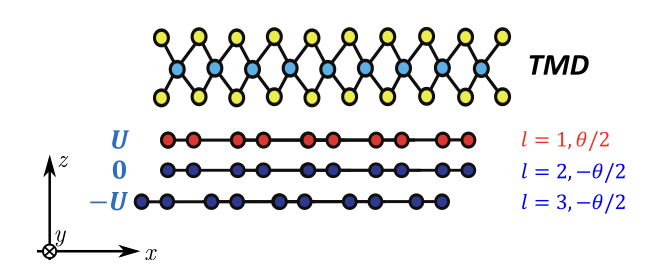
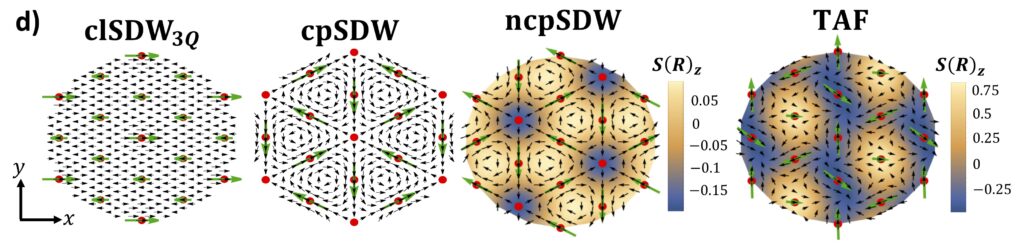
Using self-consistent Hartree-Fock calculations, we find that at integer fillings the system settles into interaction-driven insulating states that preserve the moiré crystal’s translational symmetry, while at half-integer fillings the electrons spontaneously break that symmetry — a distinction rooted in the polarization of half-filled bands. Crucially, even a small dose of SOC reshapes the spin character of these correlated phases: Ising-type SOC locks spins out of plane and ties spin tightly to valley, whereas Rashba-type SOC reorients the spin order into the plane. These results show that proximity coupling to a dichalcogenide substrate is a powerful knob for engineering and tuning the exotic phases of twisted mono-bilayer graphene.
Title: Tuning correlated states of twisted mono-bilayer graphene with proximity-induced spin-orbit coupling
Authors: Jeyong Park, Mingdi Luo, Louk Rademaker, Jurgen Smet, Mathias S. Scheurer, Laura Classen
Reference: arXiv:2603.10914